What is Arabic OCR & Developer API?
Developer API & RAG Docs →Arabic OCR is the process of using optical character recognition to extract editable Arabic text from scanned images, photos, or PDF documents while preserving right-to-left reading order, connected script, and diacritics so the output can be searched, copied, and translated. FastOCR performs Arabic OCR with AI-powered text recognition and requires no registration for image uploads. For engineering teams building RAG pipelines, vector search databases, or automated document ingestion, FastOCR also provides a high-speed Arabic OCR REST API at api.fastocr.org supporting multi-page PDF processing with 50 free pages upon allowlist approval.
تحويل الصورة إلى نص عربي
استخراج ممتاز للنصوص العربية المطبوعة بدقة تصل إلى 95%.
Right-to-left support
Native RTL text handling with correct character joining.
Connected script
Reads Arabic cursive where letters change shape by position.
Diacritics & tashkeel
Recognizes vowel marks (harakat) when present in the text.
Mixed Arabic & English
Handles bidirectional documents with both scripts.
Searchable PDF output
Creates PDFs with invisible text layer preserving RTL layout.
Translate after extraction
Extract Arabic text then translate to English or any language.
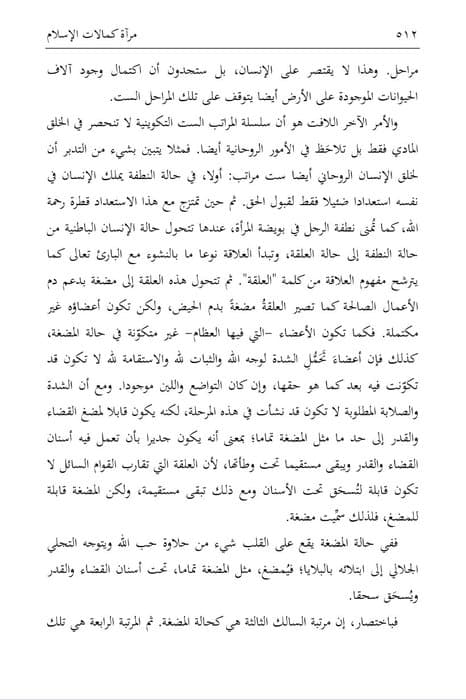
٥١٢
مرآة كمالات الإسلام

مراحل. وهذا لا يقتصر على الإنسان، بل
ستجدون أن اكتمال وجود آلاف الحيوانات
الموجودة على الأرض أيضا يتوقف على تلك
المراحل الست.

والأمر الآخر اللافت هو أن سلسلة المراتب
الست التكوينية لا تنحصر في الخلق المادي
فقط بل تلاحظ في الأمور الروحانية أيضا.
لماذا يعد التعرف الضوئي على الحروف باللغة العربية أمرًا صعبًا؟
- Right-to-left script with bidirectional text when Arabic is mixed with numbers or Latin characters
- Each of the 28 Arabic letters has up to 4 positional forms (initial, medial, final, isolated)
- Connected cursive script where characters join — incorrect segmentation breaks recognition
- Dots above and below letters distinguish many character pairs (ب/ت/ث, ج/ح/خ, د/ذ, ر/ز, س/ش)
- Optional diacritical marks (tashkeel) like fatha, kasra, damma that are often omitted in print
- Complex ligatures such as لا and combinations that change character appearance significantly
كيفية استخراج النص العربي من ملفات PDF والصور
- انتقل إلى fastocr.org
- قم بتحميل صورة أو ملف PDF باللغة العربية. سيتم اكتشاف اللغة تلقائيًا.
- انتظر المعالجة — الصور تستغرق ثوانٍ معدودة، بينما تظهر ملفات PDF شريط تقدم.
- تنزيل النتائج: ملف PDF قابل للبحث، ملف نصي خام، أو نسخ النص مباشرة.
نصائح لتحسين دقة التعرف الضوئي على الحروف العربية
- Scan at 300 DPI minimum to preserve dots and diacritics that distinguish Arabic letters
- Use clean original scans rather than photocopies which degrade fine character details
- Avoid decorative Arabic calligraphic fonts — use Naskh-style fonts for best OCR accuracy
- Separate multi-column Arabic layouts into individual columns before processing
- Check for mixed Arabic-English text and verify bidirectional text ordering in the output
حالات الاستخدام الشائعة للتعرف الضوئي على الحروف العربية
- Digitizing tafsir, hadith, and historical Islamic manuscripts for searchable study
- Extracting text from tafsir, fiqh, and seerah books
- Archiving historical Islamic manuscripts and calligraphy
- Converting madrasa textbooks to searchable digital format
- Digitizing Arabic legal documents, contracts, and court rulings
- Extracting text from Arabic academic research papers and university theses
- Processing Arabic business invoices, purchase orders, and financial records
- Converting scanned religious texts including Quran commentaries and Islamic scholarship
- Archiving Arabic government documents and historical administrative records
- Processing Arabic medical prescriptions, lab reports, and healthcare documents
- Extracting text from Arabic news articles, social media screenshots, and digital content
- Converting Arabic handwritten field notes and survey data for research purposes
FastOCR vs Standard OCR Apps for Arabic
| Capability | FastOCR Dedicated Cloud AI | Standard Online OCR Tools |
|---|---|---|
| Arabic Script Recognition | ✅ Full native cloud recognition for Arabic (Nastaliq & Naskh cursive ligatures) | ❌ Most online tools do not support Urdu or Arabic at all |
| Right-to-Left (RTL) Layout Flow | ✅ Preserves proper bidirectional RTL reading order | ❌ Scrambles character order backwards (left-to-right) |
| Searchable PDF/A Output | ✅ Dual-layer searchable PDF with coordinate-aligned text overlay | Plain unformatted text dump only or unsupported |
| Instant Web Access | ✅ Zero software installation (runs in mobile & desktop browser) | Requires local CLI libraries or complex desktop setup |
الأسئلة الشائعة
كيف يمكن تحويل الصورة إلى نص عربي أونلاين؟
يمكنك استخدام FastOCR مجاناً لرفع الصورة واستخراج النص العربي منها بضغطة زر واحدة ودون الحاجة لتثبيت أي برامج أو إنشاء حساب.
ما هي دقة استخراج النص من الصور العربية؟
يحقق FastOCR دقة تصل إلى 95% في استخراج النصوص العربية المطبوعة باستخدام تقنيات الذكاء الاصطناعي الحديثة.
What is the most accurate Arabic OCR tool?
FastOCR achieves 95% accuracy on printed Arabic text using cutting-edge AI technology. ABBYY FineReader is comparable at 93% but costs $199/year.
Does Arabic OCR work on handwritten text?
Partially. Our cutting-edge AI can recognize some handwritten Arabic with 60-75% accuracy. Printed text achieves 95% accuracy.
What is the difference between Naskh and Nastaliq for OCR?
Naskh is a horizontal, print-style Arabic script used in most modern documents — OCR engines achieve 95%+ accuracy on it. Nastaliq is a calligraphic, diagonal-flow style common in Urdu and classical texts, which is significantly harder for OCR (85-90% accuracy). Always prefer Naskh for source documents when possible.
How does FastOCR handle Arabic diacritics (tashkeel)?
FastOCR recognizes fatha, kasra, damma, and other tashkeel marks when they appear in the source document. Since most modern Arabic print omits diacritics, accuracy depends on the source. When present, our AI correctly identifies vowel marks above and below letters.
Can Arabic OCR process documents with mixed numbers and text?
Yes. FastOCR handles bidirectional text mixing Arabic script with Western Arabic numerals (0-9) and Eastern Arabic numerals (٠-٩), maintaining correct reading order for both LTR numbers and RTL text.
Dedicated Arabic Tools
Explore Specialized OCR Workflows
FastOCR provides dedicated AI text recognition engines optimized for complex document types and formats:
Free for images. No registration required.
Related Articles
Image to Text
Convert any image to editable text instantly
PDF to Text
Extract text from scanned and native PDFs
Arabic OCR Guide
In-depth guide to Arabic text extraction and best practices
Arabic PDF to Text
Extract Arabic text from scanned and native PDFs
Arabic Image to Text
Convert Arabic images to editable text online
Arabic Handwriting OCR
Convert handwritten Arabic notes and pages to text
Free Arabic OCR
Upload & Extract TextLast updated: July 24, 2026